

Tax Tips or Tax Traps? The Truth Behind Social Media Tax Advice
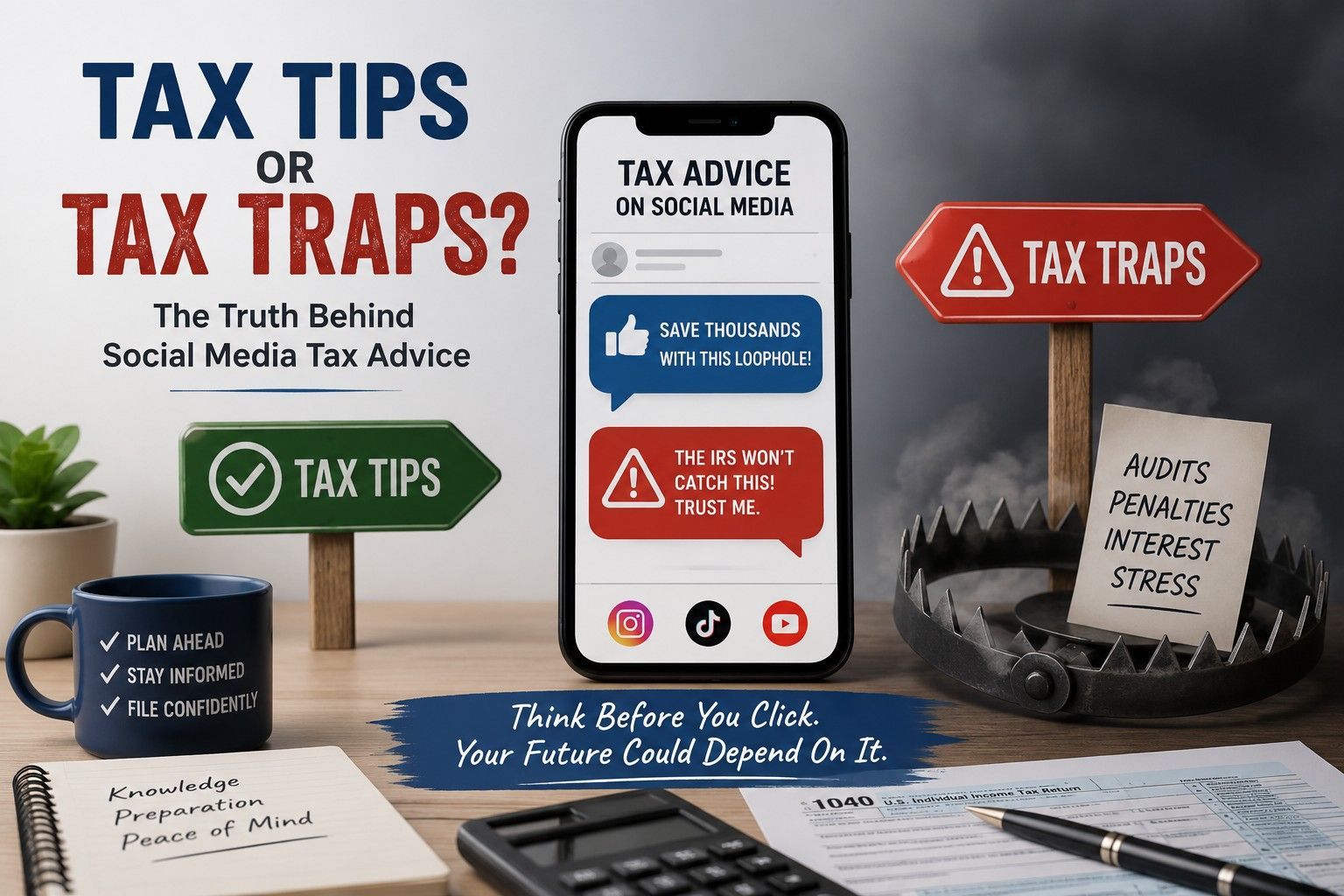
Every year, social media is flooded with "tax hacks" promising huge refunds, massive deductions, and ways to avoid paying taxes. While some strategies have a basis in tax law, many are oversimplified, misleading, or completely false.
Following bad tax advice can result in audits, penalties, interest, and costly mistakes. Before you act on something you saw on TikTok, Facebook, Instagram, or YouTube, here's what you need to know.
1. "Start an LLC and Write Off Everything!"
-MYTH-
One of the most common tax myths is that forming an LLC suddenly makes personal expenses tax deductible.
An LLC is simply a legal business structure. It does not change the rules regarding what expenses qualify as business deductions. To be deductible, expenses must be both ordinary and necessary for your business.
Common red flags include:
- Personal groceries
- Family vacations
- Everyday clothing
- Personal vehicle expenses without mileage records
If the expense would have existed whether you owned a business or not, it's probably not deductible.
2. "Everyone Qualifies for a Huge Fuel Tax Credit Refund!"
-MYTH-
The Fuel Tax Credit is not available to everyone.
This credit generally applies to fuel used for specific off-highway business purposes, such as:
- Farming operations
- Commercial fishing
- Off-road business equipment
- Refrigerated trailer units
- Certain other qualifying business activities
Claiming this credit requires detailed documentation, including fuel purchase records, equipment ownership information, usage logs, invoices, and dates of use.
Improperly claiming this credit has become so common that it has drawn significant IRS attention.
3. "Self-Employed People Can Claim Thousands in COVID Sick Leave Credits!"
-MYTH-
These credits applied only to specific tax years and qualifying circumstances.
Unfortunately, many online promoters have encouraged taxpayers to file amended returns claiming credits they do not qualify for. As a result, taxpayers may face:
- Delayed refunds
- IRS audits
- Penalties and interest
- Repayment of improperly claimed credits
If someone guarantees a large refund based on a COVID-related credit, proceed with caution.
4. "Pay Your Children and Get Huge Tax Deductions!"
-MYTH- (Sort Of)
Hiring your children can be a legitimate tax strategy—but only when done correctly.
To qualify:
- Your child must perform actual work.
- Compensation must be reasonable for the services provided.
- Proper payroll and employment records must be maintained.
IRS Red Flag: Paying a young child thousands of dollars for minimal or nonexistent work, such as claiming a five-year-old earned $20,000 for "modeling" services.
When structured properly, hiring family members can be beneficial. When abused, it can create significant problems.
5. "Take a Vacation, Post a Business Photo, and Write Off the Entire Trip!"
-MYTH-
A vacation does not become a business expense simply because you answer emails, make a phone call, or post a business-related photo.
For travel expenses to be deductible, the primary purpose of the trip must be business.
Be sure to maintain:
- A travel itinerary
- Receipts
- Dates of business activities
- Meeting notes
- Names of individuals you met with
- Documentation of business purposes
Only expenses directly related to legitimate business activities may qualify for a deduction.
6. "Rent Your Home to Your Business and Deduct Thousands!"
-PARTIALLY TRUE-
This strategy is often referred to as the "Augusta Rule," and it can be legitimate when properly implemented.
To qualify:
- Fair market rent must be charged.
- Actual business meetings or events must take place.
- The property can be rented for no more than 14 days per year.
- Proper documentation must be maintained.
Documentation should include:
- A written rental agreement
- Meeting agendas
- Attendance records
- Meeting minutes
- Evidence supporting the rental rate
One benefit of this strategy is that rental income received for qualifying rentals of 14 days or less is generally not subject to federal income tax. However, the transaction must be legitimate and properly documented.
7. "Donate Used Items and Claim Huge Deductions!"
-MYTH-
Charitable donations are deductible only at their fair market value—not what you originally paid for them.
Taxpayers should maintain:
- Donation receipts
- Itemized lists of donated property
- Reasonable fair market value estimates
- Appraisals when required
In addition, many taxpayers receive little or no tax benefit from charitable contributions unless they itemize deductions.
Keeping accurate records is essential to supporting your deduction if questions arise later.
Final Thoughts
If a tax strategy sounds too good to be true, it probably is.
Social media can be a great place to find business ideas and educational content, but it should never replace professional tax advice. Before claiming a deduction or credit based on something you saw online, consult with a qualified tax professional.
A quick conversation today could save you thousands of dollars in penalties, interest, audits, and unnecessary stress tomorrow.